For Appointment: +1 (201) 210-2315

For Appointment: +1 (201) 210-2315
A bunion is not just a bump on the side of your foot. It is a joint problem, and physical therapy can help you walk with less pain, whether or not you ever need surgery.
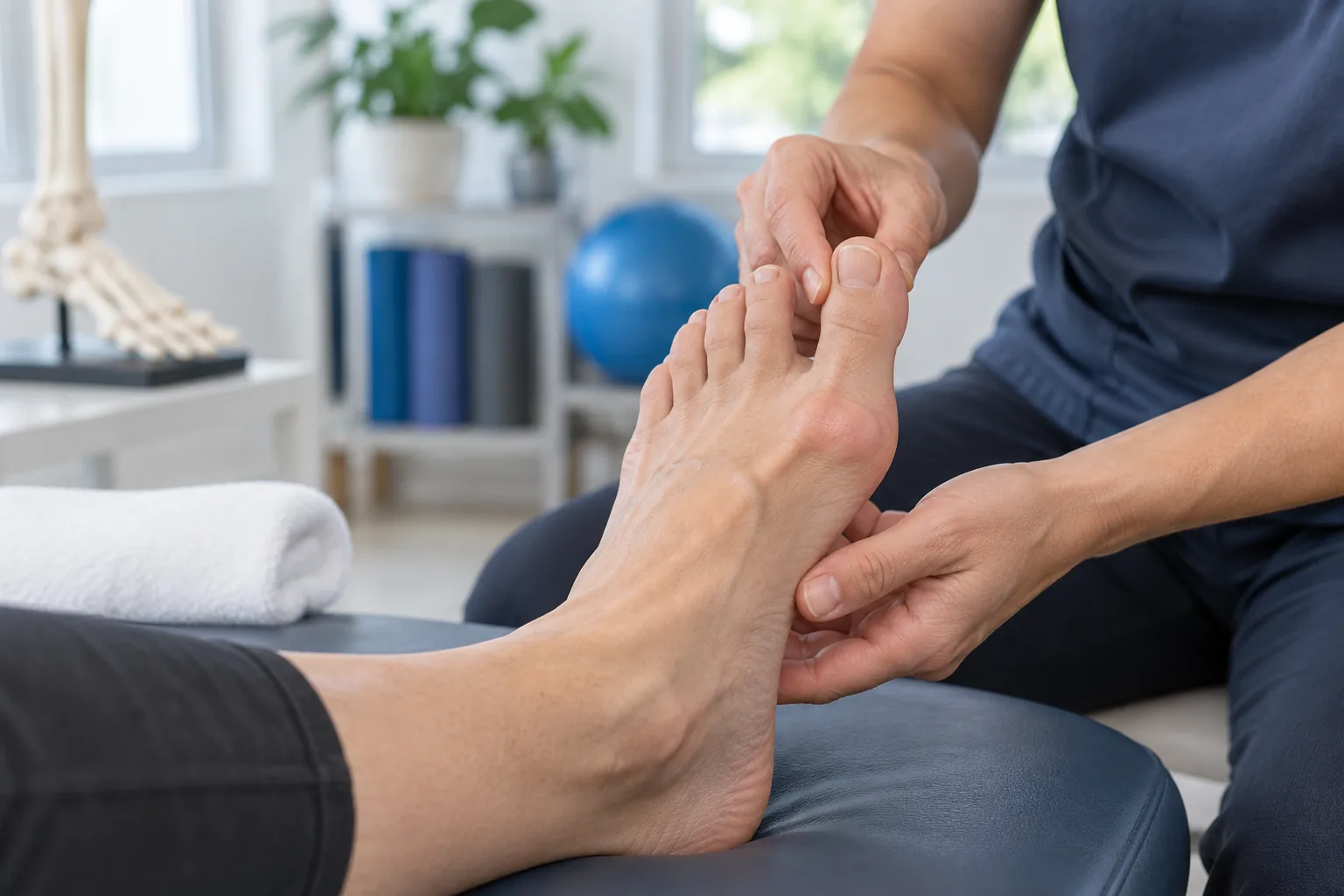
The medical name for a bunion is hallux valgus. The big toe drifts toward the second toe, while the first metatarsal bone (the long bone behind it) angles outward. That outward angle creates the visible bump at the base of the big toe.
Over time, the muscles and ligaments around the joint pull unevenly. The small muscle that should hold the big toe straight, the abductor hallucis, slides under the bone and loses its leverage. That is one reason bunions tend to get worse, and one reason targeted exercise matters.
Roughly 1 in 4 adults has a bunion, and the odds climb with age. The largest meta-analysis on the topic pooled 76 surveys covering nearly 500,000 people (Nix et al., 2010 (source)).
| Group | Share with a bunion | Source |
|---|---|---|
| Children and teens | 7.8% | Nix et al., 2010 (source) |
| Adults 18–65 | 23% | Nix et al., 2010 (source) |
| Adults over 65 | 35.7% | Nix et al., 2010 (source) |
| Women (all ages) | 30% | Nix et al., 2010 (source) |
| Men (all ages) | 13% | Nix et al., 2010 (source) |
U.S. data tell the same story. In the Framingham Foot Study (source), a population-based study of older adults in Massachusetts, 44% of women and 22% of men had a bunion. About 11% of women and 3% of men had a bunion that was also painful.
A 2023 global meta-analysis put overall prevalence at 19%, with North America at about 16% (PubMed (source)). Estimates vary by how bunions are measured, but every major dataset agrees: bunions are common, more common in women, and more common with age.
Bunions have no single cause. Researchers describe them as multifactorial: genes set the stage, and foot mechanics and footwear add load over the years.
Pain is the main reason people seek care, and it affects roughly 76–83% of people with a bunion (Frontiers in Physiology, 2025 (source)). Common signs include:
See a clinician if pain limits walking, work, or exercise, if shoes no longer fit, or if the toe is visibly getting worse. Earlier care usually means more options.
Physical therapy will not make a bone bump disappear. What it can do is reduce pain, improve how the foot works, and, in mild to moderate cases, modestly improve toe alignment and may slow progression.
For mild to moderate bunions, conservative care such as exercise therapy and external supports is the preferred first approach (Clinical Biomechanics, 2025 (source)). A network meta-analysis found the most promising results came from combining patient exercise with toe separators, along with night splints and dry needling (Int J Environ Res Public Health, 2021 (source)). The authors concluded that the best results come from pairing active exercise with therapist-led hands-on care.
A physical therapy plan for bunions typically includes:
What the evidence can and cannot tell us. A 2022 systematic review of 16 trials found that most nonsurgical studies were small and short, so certainty about any single treatment is still low (Hurn et al., 2022, via PEDro (source); Menz et al., 2023 (source)). That is why a good therapist combines approaches and tracks your progress, rather than relying on one gadget or exercise.
Surgery corrects the bones, but it does not automatically restore a normal walking pattern. Pressure studies show that even after a well-aligned correction, the big toe and first metatarsal often carry less weight than they should (Schuh et al., 2009 (source)). Rehab closes that gap.
In a study from the Foot and Ankle Center Vienna, 30 patients started a multimodal rehab program 4 weeks after surgery, once a week for 4 to 6 weeks. Their foot function score (AOFAS) rose from 60.7 before surgery to 94.5 at 6 months. Big toe range of motion improved, and the big toe carried more load when walking (Physical Therapy journal (source)). The study had no control group, but a related study by the same team reached the same conclusion: post-op physiotherapy helps restore big toe function and a normal gait (PubMed (source)).
A typical recovery path looks like this. Exact timing depends on your procedure and your surgeon's protocol.
These are common starting points in bunion rehab. Stop if any exercise causes sharp pain, and ask a physical therapist to tailor them to you.
Everyday habits that help: choose shoes with a wide, deep toe box, keep heels low, avoid long stretches in tight footwear, and ice the joint after a long day on your feet.
Whether you want to avoid surgery or recover fully after it, our therapists build a plan around your foot, your goals, and the latest evidence. We see patients at five New Jersey locations: Secaucus, Hackensack, Edison, East Orange, and West Orange.
This article is for general education and is not a substitute for a medical evaluation. Talk with your physician or physical therapist about your specific condition.



Beyond Radix Physical Therapy is dedicated to restoring mobility, reducing pain, and helping patients move confidently through personalized, evidence-based care delivered by experienced physical therapists.

Beyond Radix Physical Therapy – © . All rights reserved.
Beyond Radix Physical Therapy provides personalized, evidence-based rehabilitation services to help you move better, recover safely, and live pain-free. Our expert therapists focus on long-term results and compassionate care.